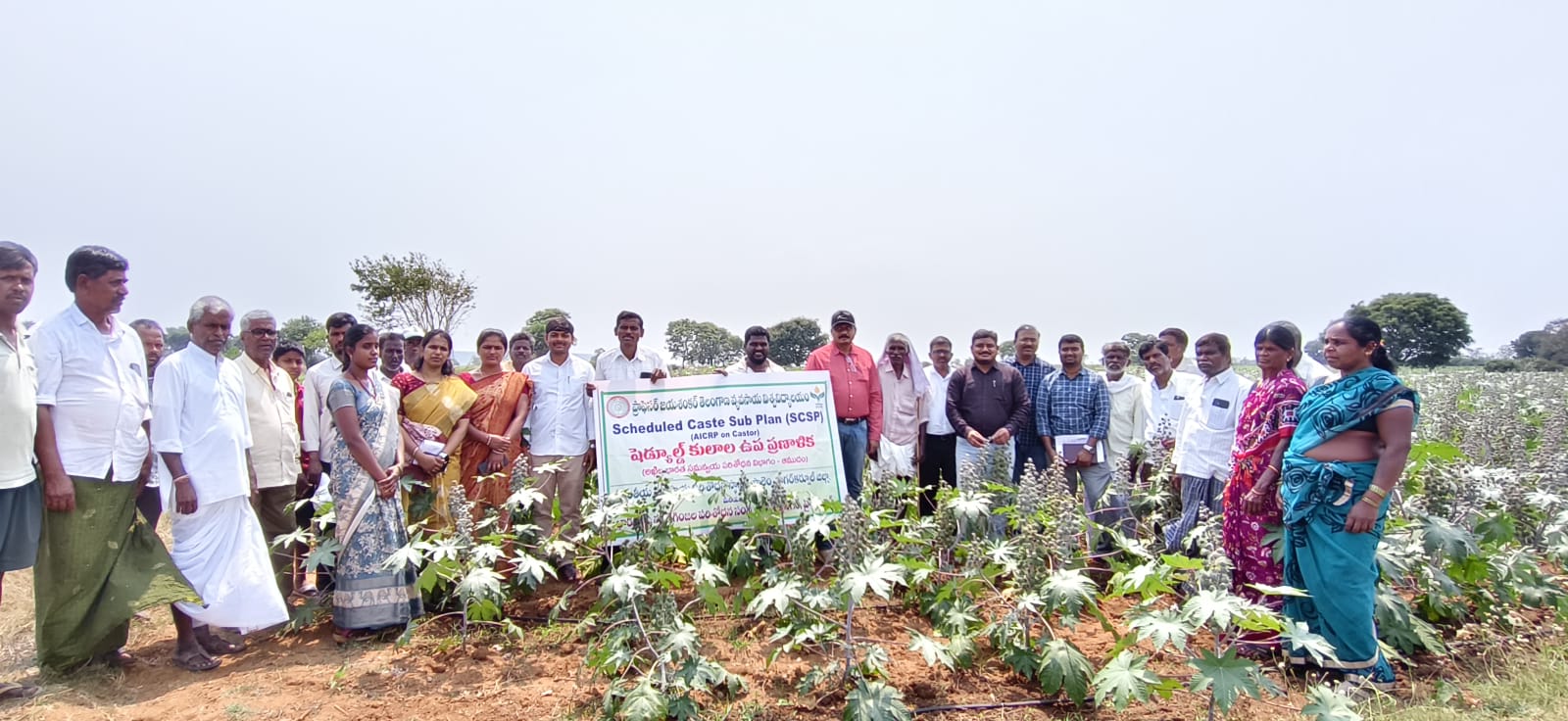
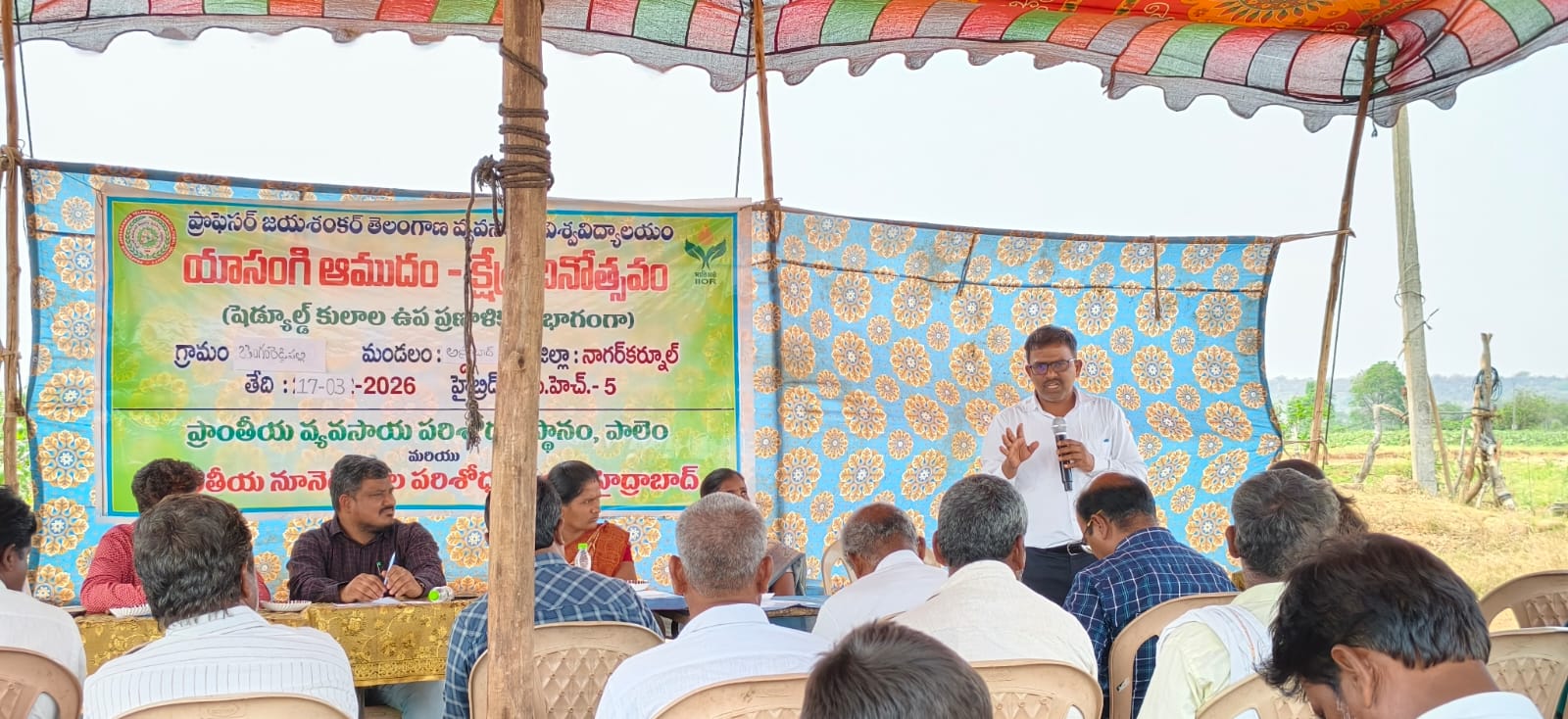
Field day of rabi castor at Farmer’s field under “Praja Palana - Pragati Pranalika: 99 days action plan” at Ngarkurnool district on 17.03.2026 by RARS Palem.
A field day was organized on 17th March, 2026 at Jangamreddypalli village, Amrabad mandal, Nagarkurnool district, as part of the “Praja Palana - Pragati Pranalika: 99 Days Action Plan” to promote rabi castor cultivation under the Scheduled Caste Sub-Plan (SC-SP). The programme aimed to enhance the area and productivity of rabi castor by demonstrating improved production technologies. The field day was conducted at the farmer’s field of Sri Ch. Niranjan, where the high-yielding castor hybrid ICH-5 was demonstrated. The programme focused on creating awareness among farmers regarding the adoption of improved technologies, particularly high-yielding cultivars, to increase productivity, profitability and area expansion under rabi castor cultivation. The event was organized by the team of scientists from AICRP on Castor, RARS, Palem, comprising Dr. K. Sadaiah, Scientist (Plant Breeding), Dr. M. Shankar, Scientist (Entomology), Mrs. K. Mamatha, Scientist (Agronomy) and Dr. G. Eswara Reddy, Scientist (Plant Breeding) along with Dr. M. Sreedhar, Principal Scientist (Oilseeds). The programme was conducted under the chairmanship of Dr. L. Krishna, Associate Director of Research, RARS, Palem. At the outset, Dr. K. Sadaiah highlighted the significance of the programme and emphasized the need to expand castor cultivation in the state. He also informed farmers about the availability of quality seed at RARS, Palem. The host farmer, Sri Ch. Niranjan shared his experiences and crop management practices adopted for raising a healthy crop. An interactive session followed, during which farmers raised queries related to best management practices, pest and disease management and marketing opportunities in castor. Addressing the gathering, Mrs. K. Mamatha elaborated on improved agronomic practices for achieving higher yields. Dr. M. Shankar discussed effective pest and disease management strategies while Dr. M. Sreedhar emphasized the importance of rabi castor cultivation under irrigated conditions and appreciated farmers for adopting the crop. Dr. L. Krishna highlighted the importance of traditional crops of the region and stressed the need for maintaining soil health and nutrient status to achieve sustainable yields. He also discussed various opportunities for farmers to get acquainted with the latest agricultural technologies. The programme concluded with a field visit to the ICH-5 demonstration plot, where farmers observed the crop performance and interacted with scientists regarding varietal traits, crop management, and pest control measures.